THE KNOWN SPECIES OF EPIPHYTIC CACTI
THIS SECTION IS CURRENTLY UNDER CONSTRUCTION SO PLEASE EXCUSE THE INCOMPLETE AREAS, grammar and or missing picture links,links to specific species etc.In order to supply the most comprehensive information from many sources the estimated completion date is on or around January 1st,2012.THANK YOU FOR YOUR PATIENTS DURING CONSTRUCTION-WATCH THE PROGRESS AS MORE IS ADDED OR UPDATED.
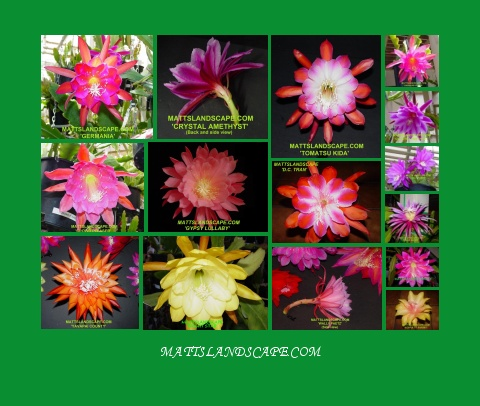
Epiphyllum Hybrids have been made by the crossing of one Epiphyllum species to another Epiphyllum species-(Epiphyllum x Epiphyllum) and Epiphyllum to many of the Epiphytic species below which are closely related to Epiphyllum. In fact if you look at parentage you will find out that many of the early Epi hybrids were derived by crosses made by early hybridizers of the Epiphytic Cacti listed below. In fact you will find Epiphyllum X Disocactus alone has hundreds of registered hybrids from those two being crossed, along with many others.
Most of the species are nocturnal or (night blooming), have white blooms, a few are pink or purple and some even reddish, a few bloom during the day also-crosses with these are how Hybrid day bloomers began. There growth characteristics can vary greatly though from one species to another. A few have such exact temperature requirements that you will rarely find them in any collections or outside of there native habitat.
APOROCACTUS
DISOCACTUS
EPIPHYLLUM
HELIOCEREUS
HYLOCEREUS
LYMANBENSONIA
NOPALXOCHIA
RHIPSALIS
SCHLUMBERGERA
SELENICEREUS
TRICHOCEREUS
WEBEROCEREUS
APOROCACTUS or (rattail cactus as they're commonly called)
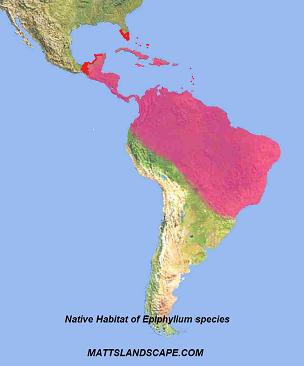
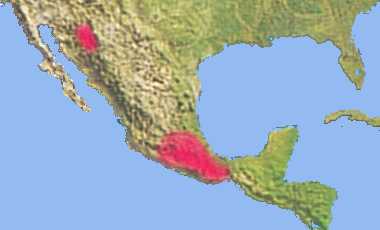
The native habitat range of Aporocactus
Although there are many hybrids called Aporophyllums made from crosses of the two species below. Aporocactus have only two species of epiphytic cacti and a few variations of the two, both species are described below.
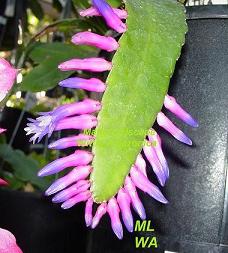
Aporocactus growth is cylindrical in form with many ribbed densly spiny stems, rope like growth. They grow best in hanging basket form and can be vining in there natural habitat. The blooms of both species are tubular or trumpet in form. The blooms can be colored red or purplish. This Genus is closely related to Heliocereus listed below.
1) A. flagelliformis (L.) Lem. 1753. (A. flagriformis, A. leptophis). Native to Mexico. Stems are very thin, flower tube is upcurving
near base, petals purplish to purplish red.
2) A. martianus (Zucc.) Britt. & Rose. 1832. (A. conzattii). Native to Mexico. Stems are thicker, flower tube less upcurving near
base, petals are red.
DISOCACTUS
(Wittia, Wittiocactus, Chiapasia, Pseudorhipsalis, Bonifazia)
Twelve species of flat-stemmed spineless epiphytes native to several Latin American countries. Flowers small, tubular to
expanded, red to yellowish or white. Three groups can be recognized: section Disocactus with red, tubular to expanded
flowers, and section Wittiocactus, with straight, short, tubular, unexpanded flowers, the flowers of both sections being
pollinated by hummingbirds; and section Pseudorhipsalis, with whitish, expanded, bee-pollinated flowers.
1) D. acuminatus (Cuf.) Kimn. 1933. (Pseudorhipsalis acuminata). Costa Rica. Stems 3-4 cm wide; fls. expanded,
10-15 mm long, yellowish white. A rare and difficult-to-grow species.
2) D. alatus (Swartz) Kimn. 1788. (Pseudorhipsalis alata). Jamaica. Fls. expanded, 14-17 mm long, yellowish.
3) D. amazonicus (Schum.) Hunt. 1903. (Wittia amazonica, W. panamensis, Wittiocactus amazonicus). Costa Rica,
Panama, Venezuela, Colombia, Ecuador, Peru. Fls. tubular, 3-4 cm long, tube red, apex blue. The only cactus with
blue in its flowers. If given generic status, its proper name is Wittiocactus amazonicus.
4) D. biformis (Lindl.) Lindl. 1843. Guatemala. Stems mostly cylindrical, with flattened apex. Flowers pinkish-red,
4.5-6 cm long, outer petals expanded, inner petals tubular.
5) D. eichlamii (Weing.) Britt. & Rose. 1911. Guatemala. Stems cylindrical, with flattened apex. Fls. tubular, 6-8 cm
long, purplish-red, petals not expanding.
6) D. himantocladus (Rol.-Goss.) Kimn. 1908. (Pseudorhipsalis himantoclada). Costa Rica. Fls. expanded, ca. 2 cm
long, orange-white.
7) D. horichii Kimn. 1979. Costa Rica. Fls. expanded, 10-12 mm long, greenish white. Closely related to D. acuminatus
but with narrower, erect stems.
8) D. lankesteri Kimn. 1979. Costa Rica. Fls. expanded, 19-24 mm long, white. Difficult to grow and flower.
9) D. macranthus (Alex.) Kimn. & Hutchis. 1942. (Pseudorhipsalis macrantha). Mexico. Stems green or glaucous. Fls.
expanded, 5-8 cm long, 5-9 cm wide, yellowish white, fragrant. Much-used in hybridzing.
*'Glaucocladus' ("D. macranthus var. glaucocladus", invalid name). 1989. Stems bluish glaucous.
10) D. nelsonii (Britt. & Rose) Lindl. 1913. (Chiapasia nelsonii). Mexico, Guatemala, Honduras. Fls. expanded, 9-11 cm
long, 5-7 cm wide, purplish pink. Much-used in hybridizing.
*var. nelsonii. Mexico, Guatemala. Stems cylindrical, with flattened apex; anthers and stigma yellow.
*var. hondurensis Kimn. 1965. Honduras. Stems mostly flattened; anthers and stigma purple.
11) D. quezaltecus (Standl. & Steyerm.) Kimn. 1944. (Bonifazia quezalteca). Guatemala. Fls. tubular, 8-9 cm long,
purplish pink, petals not expanding.
12) D. ramulosus (S.-D.) Kimn. 1834. (Pseudorhipsalis ramulosa, Rhipsalis ramulosa, R. coriacea, R. leiophloea, R.
purpusii). Jamaica, Haiti, Mexico, south to Peru. Fls. expanded, 7-12 mm long, whitish.
var. ramulosus. Stems thinner, pinkish when young, 2-4 cm. wide.
var. ramulosus forma angustissimus (Web.) Kimn. 1902. (Rhipsalis angustissima). Costa Rica. Stems 5-8 mm wide.
var. jamaicensis (Britt. & Harris) Kimn. 1909. (Rhipsalis jamaicensis). Jamaica. Stems thicker, never pinkish.
EPIPHYLLUM
(Examples; a wide range of Epiphyllum Hybrids that have been developed from species over time, most are day blooming).
Haworth. 1812.
(Phyllocactus, Marniera)
About 12 species of scandent-pendent cacti distributed throughout most of Latin America. Stems flat, at least apically.
Flowers usually nocturnal, rarely diurnal (staying open all day, as in E. crenatum and E. laui), funnelform, white to yellowish in color.
1) E. anguliger (Lem.) Don. 1851. (E. darahii, E. "beahmianum" [invalid name], E. "gertrudeanum" [invalid name]).
Mexico. Stems ca. 7 cm wide, margins with long, acute to obtuse lobes. Flowers ( cm long, outer petals
opening 11-13 cm wide, the inner opening 6 cm wide. The stems closely resemble those of
Selenicereus anthonyanus
and Weberocereus imitans.
Click above to see more images of E. darahii
2) E. cartagense (Web.) Britt. & Rose. 1902. Costa Rica. Stems mostly cylindrical, widening apically to 2-8 cm.
Flowers 15-21 cm long.
3) E. caudatum Britt. & Rose. 1913. Mexico. Lower stems cylindrical, apical portion flat and 3-4 cm wide. Flowers
12-15 cm long. Closely related to E. cartagense.
4) E. crenatum (Lindl.) Don. 1844. Stems fleshy, crenate, green to glaucous. Flowers day-blooming, 19-29 cm long.
*var. crenatum (E. Kinchinjunga'). Mexico, Guatemala, El Salvador, Honduras. Flowers with a few prominent scales
on base, spines few or lacking, outer petals attached near apex of tube.
var. crenatum 'Chichicastenango'. Variant from Guatemala with abnormally few and distorted stem-lobes.
*var. kimnachii Bravo. 1964. (Epiphyllum ×cooperi, ×Seleniphyllum cooperi, Marniera macroptera var. kimnachii).
Mexico. Base of flower with smaller, more numerous scales and profuse spines or bristles, outer petals attached farther
down on tube. E. ×cooperi, incorrectly described as a hybrid between E. crenatum and Selenicereus grandiflorus, is
indistinguishable from wild plants of var. kimnachii.
*E. floribundum Kimn. 1990. Peru? Stems 3-5 cm wide. Flowers often several from an areole, 9-12 cm long,
opening 8-10 cm, remaining open a day or more, outer petals reddish orange, inner petals light yellow. Fruit ca. 2 cm
long and 1.5 cm thick, red. Although supposedly collected wild in Peru, the plant is probably a hybrid of Disocactus
macranthus and should be called ×Disophyllum'Floribundum'.
5) E. grandilobum (Web.) Britt. & Rose. 1902. (E. gigas). Costa Rica, Panama. A vigorous vine to 300 feet or more,
stems 15-25 cm wide, crenate. Flowers 32-38 cm long, 26-30 cm wide (one of the largest of cactus flowers).
6) E. laui Kimn. 1990. Mexico. Stems soft, shiny, 5-7 cm wide, crenate, with sparse hair-like spines. Flowers
day-blooming, ca. 18 cm. long, ca. 8 cm wide, outer petals yellow, inner white.
7) E. lepidocarpum (Web.) Britt. & Rose. 1902. Nicaragua, Costa Rica, Panama. Stems linear, 3-5.5 cm wide, with
white hairs to 10 mm long. Flowers 15-22 cm long, 15-19 cm wide, the base with linear scales to 12 mm long and
hairs to 3 mm long. Requires cool growing-conditions.
8) E. oxypetalum (DC.) Haw. 1828. (E. oxypetalum var. purpusii). Mexico, Guatemala, Honduras. Stem mostly
cylindrical, apex widened to 4-9 cm. Flowers 27-34 cm long, ca. 20 cm wide.
9) E. phyllanthus (L.) Haw. 1753. Latin America. Stems linear, of firm texture, often brown-margined. Flowers with
petals at right angles to tube, tube slender, long or short. A variable, widely dispersed species best divided into the
following varieties.
var. phyllanthus (E. phyllanthus var. boliviense, E. phyllanthus var. paraguayense). Panama, Cuba, Antigua, Guyana,
Colombia, Ecuador, Peru, Bolivia, Argentina, Brazil, Paraguay. Flowers 20-29 cm long, 4-9 cm wide.
var. columbiense (Web.) Back. 1898. Costa Rica, Panama, Colombia, Ecuador. Flowers ) cm long, 4.5-6
cm wide.
var. guatemalense (Britt. & Rose) Kimn. 1913. (E. guatemalense). Mexico, Guatemala. Flowers ( cm
long, 20-23 cm wide.
*var. hookeri (Haw.) Kimn. 1829. (E. hookeri, E. stenopetalum, E. strictum). Mexico, Guatemala, Belize, Honduras,
Costa Rica, Trinidad & Tobago, Guyana, Venezuela. Flowers ( cm long, 10-15 cm wide..
var. pittieri (Web.) Kimn. 1898. (E. pittieri). Costa Rica, Panama. Flowers ) cm long, 7-9(-10) cm
wide.
var. rubrocoronatum Kimn. 1964. (E. rubrocoronatum). Panama, Colombia, Ecuador. Flowers 24-29 cm long, 9-11
cm wide, stamens orange to purple.
var. schnetteri Peukert. 1991. Colombia. Flowers 27-34 cm long, 3-4 cm wide.
10) E. pumilum Britt. & Rose. 1913. Guatemala, Belize. Flowers 8-12 cm long. Closely related to E. cartagense and E.
caudatum.
11) E. ruestii (Weing.) Back. 1914. Honduras. Little-known species, perhaps an ally or synonym of E. thomasianum.
12) E. thomasianum (Schum.) Britt. & Rose. Stems cylindrical on basal half, flattened apical portion with wide but nearly
flat lobes. Flowers 28-34 cm long, 20-26 cm wide.
var. costaricense (Web.) Kimn. 1902. (E. costaricense, E. macrocarpum). Costa Rica, Panama. Stem-base angled,
hairy, stem-margins brown. Base of flower hairy, petals 9-10 cm long.
var. thomasianum 1895. (E. macropterum var. thomasianum). Mexico, Guatemala, Honduras, Nicaragua, ?Ecuador.
Stem-base cylindrical, hairless, stem-margins green. Base of flowers hair less, petals 12-13.5 cm long.
HELIOCEREUS
(Berger) Britt. & Rose. 1909.
Four saxicolous or epiphytic, extremely variable species from Mexico, Guatemala, El Salvador, Honduras, and Nicaragua.
Stems flat to 3-4-angled, often spiny or hairy. Flowers funnelform, tube spiny or hairy, petals red, orange or purplish, rarely
white. A large percentage of orchid cacti have Heliocereus speciosus in their ancestry. The genus is hardly seperable from
Nopalxochia.
1) H. aurantiacus Kimn.
1974. Stems narrow, 3-angled, rarely flat, with thin spines. Flowers orange-red, tube with a few
thin hairs.
var. aurantiacus. Honduras, Nicaragua. Stems thin. Flowers cm long, 11 cm wide, base with a few weak
spines.
*var. blomianus Kimn. 1990. ("H. elegantissimus" of nurseries). Mexico. Stems thicker. Flower larger, reddish
orange, anthers and upper part of style and stamens purplish.
2) H. cinnabarinus (Eichl.) Britt. & Rose. 1910. (H. heterodoxus). Mexico, Guatemala, El Salvador. Stems slender,
sometimes flat and broad (H. heterodoxus), spines bristle-like. Flowers 12-16 cm long, spines equally long and
numerous along entire tube, petals not expanding widely, subobtuse, scarlet.
3) H. schrankii (Zucc.) Britt. & Rose. 1834. (H. elegantissimus). Mexico. Stems stouter than in H. cinnabarinus, spiny.
Flowers 10-16 cm long, spiny only near base, petals expanding more abruptly, acute, red.
var. schrankii. Inner petals widest near middle, more than 1 cm wide, red.
var. helenae (Scheinv.) Kimn. 1981. Inner petals widest near middle, flesh-red, often yellowish-tinged.
var. luzmariae Scheinv.) Kimn. 1985. Inner petals widest near tip, red.
var. stenopetalus (Bravo) Kimn. 1966. (H. elegantissimus var. stenopetalus). Inner petals less than 1 cm wide.
4) H. speciosus (Cav.) Britt. & Rose. 1803. (H. speciosus var. superbus, H. speciosus var. serratus). Mexico. Plant
usually saxicolous. Stems usually upright, with many strong spines. Flowers 15-17 cm long, very spiny, petals obtuse,
red with purplish tinge. The purplish floral-color in many epiphytic cactus hybrids is inherited from this species.
*'Amecamensis'. An albino form with white petals.
HYLOCEREUS
(Berg.) Britt. & Rose. 1909.
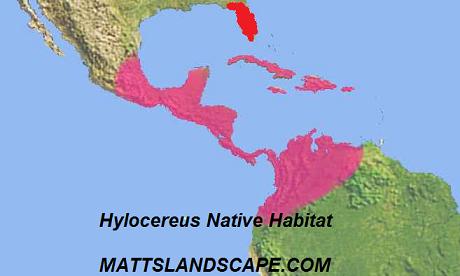
About 15 species widespread in Latin America. Stems clambering, triangular, more or less spiny. Fls. usually large to very
large, rarely small, nocturnal, the base usually spineless and with large overlapping scales, or rarely with small, separated
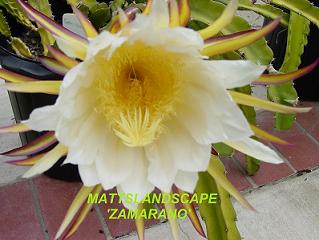
scales and sometimes spiny (H. trigonus), petals usually white, rarely red (H. extensus, H. stenopterus). Three of the ones listed below maybe varieties of one of the 15 as there very similar. Several crosses have been made in Hylocereus for fruit production and huge blooms. These are commonly called Dragon Fruit. You can view the many varieties available of Fruiting Dragon Fruit on this website by clicking the link below the picture.
1) H. calcaratus (Web.) Britt. & Rose. 1902. Costa Rica. Stems soft, green, strongly lobed. Fls. 35-37 cm long, 20-30
cm wide.
2) H. costaricensis (Web.) Britt. & Rose. 1909. Costa Rica, Nicaragua. Stems waxy-white. Fls. ca. 30 cm long. Similar
to H. guatemalensis.
3) H. escuintlensis Kimn. 1984. Guatemala. Stems green, brown-margined. Fls. 28-31 cm long, 24-36 cm wide.
4) H. extensis (S.-D.) Britt. & Rose. 1828. Trinidad. Fls. large, innermost petals rosy white. A questionable species not
known to be in cultivation.
5) H. guatemalensis (Eichl.) Britt. & Rose. 1911. Guatemala. Stems waxy-white. Fls. ca. 30 cm long. Similar to H.
costaricensis.
6) H. lemairei (Hook.) Britt. & Rose. 1854. Trinidad, Tobago, Surinam. Stems gray-green. Fls. 27 cm long, petals
white, tinged pinkish near base.
7) H. minutiflorus Britt. & Rose. 1913. (Wilmattea minutiflora). Guatemala, Honduras. Stems green. Flowers with rigid
spines at base of flower, 5 cm long, 8-9 cm wide, white. Often placed in its own genus, Wilmattea, due to its small,
spiny flowers.
8) H. monacanthus (Lem.) Britt. & Rose. 1845. Colombia, Panama. Stem with 1-2 minute spines. Fls. 28 cm long, 17
cm wide.
9) H. ocamponis (S.-D.) Britt. & Rose. 1850. Mexico. Stems white-waxy, spines needle-like, 5-12 mm long. Fls. 25-32
cm long. Separated from H. purpusii only by its longer, thinner spines. New growth is lime green in color turning grey/green with a white waxy layer as the stems mature.
10) H. polyrhizus (Web.) Britt. & Rose. 1897. (?H. estebanensis). Colombia, Panama, Venezuela, Ecuador. Fls. 25-30
cm long.
12) H. purpusii (Weing.) Britt. & Rose. 1909. Mexico. Stems white-waxy, spines short and thick. Fls. 25-28 cm long,
20-25 cm wide. Closely allied to H. ocamponis.
13) H. scandens (S.-D.) Back. 1850. Guyana. Stems bluish green. Fls. unknown. A little- known, questionable species.
14) H. stenopterus (Web.) Britt. & Rose. 1902. Costa Rica. Stems thin, soft, green. Fls. 9-10 cm long, 13-15 cm wide,
tube nearly lacking, petals purplish red. The small dark-red flowers are
untypical of the genus.
15) H. triangularis (L.) Britt. & Rose. 1753. (H. cubensis). Cuba, Haiti, Dominican Republic, Jamaica. Stems green. Fls.
ca. 20 cm long, base with wide overlapping scales.
16) H. trigonus (Haw.) Saff. 1812. (H. napoleonis, H. antiguensis). West Indies (Puerto Rico south to Grenada). Stems
green. Fls. ca. 22 cm long, 21 cm wide, base with small, narrow, widely spaced scales, sometimes spiny.
17) H. undatus (Haw.) Britt. & Rose. 1830. Native habitat uncertain, widely cultivated in the tropical regions. Used as a cross for many fruit producing varieties. The most commonly found in collections of the Hylocereus. Stems green,
margins undulate and brown. Fls. 25-30 cm long.
18) H. venezuelensis Britt. & Rose. 1920. (?Wilmattea venezuelensis). Venezuela, ?Ecuador. Fls. 23-28 cm long.
Closely allied to H. polyrhizus.
LYMANBENSONIA
A genus mainly differing from Rhipsalis by the presence of a floral tube over a centimeter long. The single species is terrestrial.
1) L. micrantha (Vaup.) Kimn. 1913. (Rhipsalis asperula, Acanthorhipsalis micrantha, Lepismium micranthum). Peru.
Stems 2-3-angled, spiny. Flowers 27 mm long, red, inner petals hardly expanding.
NOPALXOCHIA
Britt. & Rose. 1923.
(Pseudonopalxochia, Lobeira)
A genus hardly separable from Heliocereus, from which it differs in its flattened stems and less spiny or hairy flowers.
1) N. ackermannii (Haw.) Knuth. 1829. (Epiphyllum ackermannii). Mexico. Fls. large, petals usually red. Not to be
confused with N. ×hybrida Ackermannii', an old and widely cultivated hybrid.
*var. ackermannii. Petals 7-10 cm long, red. Prominent in the ancestry of many epiphytic cactus hybrids.
var. ackermannii 'Candida'. 1947. (Nopalxochia ackermannii forma candida). Native range unknown. Petals 7-10 cm
long, white.
*var. conzattiana (MacD.) Kimn. 1947. (N. conzattiana, Pseudonopalxochia conzattiana). Petals 4-6 cm long, red.
2) N. horichii Kimn 1984. (Disocactus kimnachii). Costa Rica. Stems flat but very thick. Fls. ca. 17 cm long, 13 cm
wide, rosy pink.
3) N. macdougallii (Alex.) Marsh. (Lobeira macdougallii). Mexico. Stems flat, thick. Fls. 7-8 cm long, 6.5 cm wide,
purple. Difficult to grow.
4) N. phyllanthoides (DC.) Britt. & Rose. 1813. Mexico. Fls. 9-10 cm. long, 5 cm wide, campanulate (inner petals
incurving), rosy pink. Plants of this species are sometimes called "Deutsche Kaiserin", a name correctly associated only
with ×Heliochia Deutsche Kaiserin', a hybrid of ×Heliochia Hybrida' and N. phyllanthoides.